
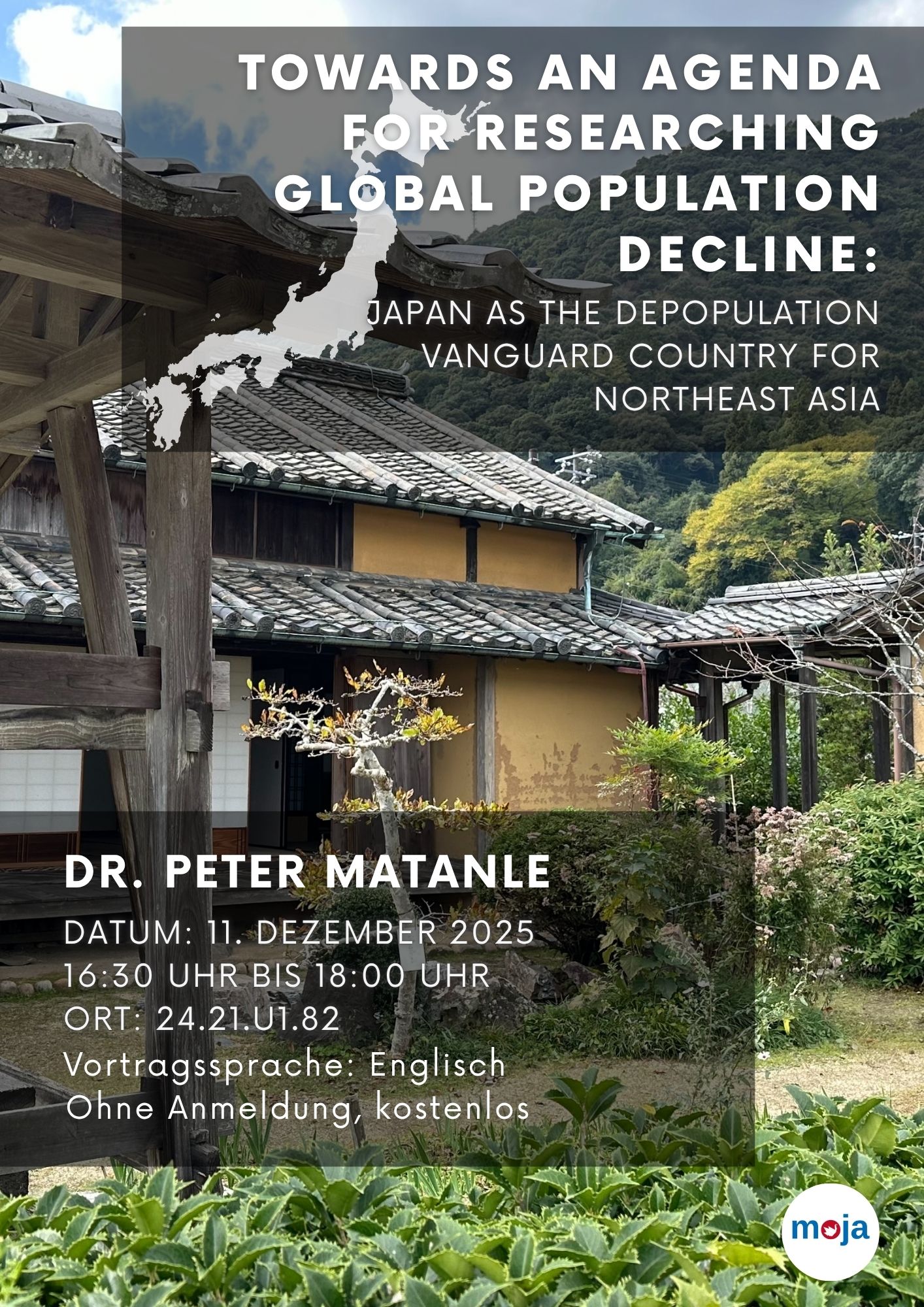
Am Donnerstag, den 11. Dezember, um 16:30 Uhr dürfen wir Dr. Peter Matanle (Gastforscher an der Shanghai University) für einen Vortrag mit dem Titel „Towards an Agenda for Researching Global Population Decline: Japan as the Depopulation Vanguard Country for Northeast Asia“ am Institut für Modernes Japan begrüßen. Der englischsprachige Vortrag wird im Raum 24.21.U1.82 stattfinden. Modernes Japan-Studierende sind herzlich eingeladen, eine vorherige Anmeldung ist nicht nötig.
Abstract des Vortrags:
For the first time in human history stable, wealthy, and healthy societies across the world are having fewer children than they need to reproduce themselves. By 2050, the UN estimates that more than 80 countries will be in continuous population decline. Most of these are developed countries in Europe and Asia. But other world regions are also affected. As yet, little is known about the potential impacts this global transformation may have on society, the economy, and the natural environment.
In Asia, Japan was the first to encounter population decline, beginning in 2008. Other Asian countries, including China and South Korea, are following suit. With similar geographies and developmental pathways, it is possible to think of Japan as the forerunner and exemplar for understanding the outcomes of depopulation in Northeast Asia – what I term a ‚Depopulation Vanguard Country‘ (DVC). Can we do similar for other world regions and identify countries whose experiences of depopulation will be instructive for their neighbours as they tackle the grand challenges of our age?
Many people assume that depopulation will have negative socio-economic but positive environmental impacts. What happens when the labour force contracts but there are no longer enough migrants to fill the gaps? Does nature really rebound when there are fewer people around to work the land? But are these assumptions true? Have these outcomes happened in Japan?
In this talk Dr. Peter Matanle will propose a global theory for Depopulation Vanguard Countries (DVCs), identify DVCs for each world region, and focus on Japan as a case study. He will conclude by suggesting a research agenda for identifying current and future risks and opportunities for countries as they begin to depopulate.
Zum Vortragenden:
Dr. Matanle ist Gastwissenschaftler am Asian Demographic Research Institute der Universität Shanghai in China. Er erwarb seinen BA an der Universität Cambridge und promovierte an der Universität Sheffield in Großbritannien. Bis Juli dieses Jahres war er Dozent an der School of East Asian Studies der Universität Sheffield. Seine jüngste Veröffentlichung in Nature Sustainability (Uchida, Matanle, Yang, Fujita & Hiraiwa, 2025) befasst sich mit der Entvölkerung und Biodiversität in den ländlichen Agrarregionen Japans. Er ist Autor zahlreicher Artikel, Kapitel, Bücher und Website-Beiträge zu diesem und anderen Themen im Zusammenhang mit der Humangeographie Ostasiens.